Lessons Learned from Molecular Glue Discovery Campaigns (Part 3)
Discovery of molecular glues is frequently perceived as serendipitous. Drawing on 12 fragment-based molecular glue screening campaigns across diverse protein pairs, we highlight here ten practical lessons that consistently influenced screening outcomes. In Part 1 and Part 2 of the series we have shown that intrinsic affinity between the protein matter and that cooperativity is key in finding moleucular glues. We have shown that molecular glues are actually way more common than expected, provided that the screening assays are well set up. In this Part, we will explore how to validate promising chemotypes, distinguish binary affinity from cooperativity and use structural information and early analogue exploration to guide molecular glue optimization.
Lesson 8: Rapid analogue exploration provides early validation and direction
Many hits can potentially come from a molecular screen, it’s important that these hits are trackable and can be followed up. For each confirmed molecular glue hit, we typically evaluate approximately ten structurally related compounds from the ZoBio in-house collection where available. While this initial set does not provide a full SAR, it often provides valuable insight into the tractability of the chemotype and the sensitivity of molecular glue activity to structural modification [25] [26].
With molecular glues, even small structural changes have resulted in pronounced differences in molecular glue activity[21][22]. In some cases, substitutions are well tolerated, while in others they abolish cooperativity entirely. More strikingly, modifications such as conversion of an amide into a carboxylic acid can transform a cooperative binder into a conventional inhibitor, illustrating how small changes can profoundly alter the mechanism of action[29].
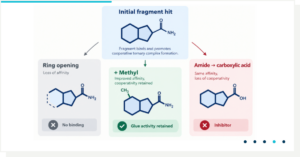
Figure 9 | Early analogue exploration rapidly validates molecular glue chemotypes. Evaluation of ready-to-go analogues around an initial fragment hit reveals initial structure-activity like relationships, 10 close analogues were tested. Certain modifications are tolerated such as introducing a methyl group, others like opening the scaffold result in loss of all affinity. Interestingly, changing the amide group into a carboxylic acid fundamentally changed the mode of action from molecular glue to inhibitor, the intrinsic affinity remains the same, but the cooperativity flips below 1. Such patterns provide strong evidence that the original hit represents a genuine and chemically tractable molecular glue chemotype.
The primary objective of this analogue exploration is not necessarily to improve potency, although more potent compounds are occasionally identified. Instead, the goal is to determine whether the observed activity follows a coherent SAR-like pattern and to establish which regions of the molecule contribute to binding and cooperativity. This provides an early indication of optimization potential and helps prioritize chemotypes for following up (or as important: not to follow-up) and build a foundation for subsequent medicinal chemistry and structure-based design efforts.
Lesson 9: Binary affinity and cooperativity are distinct, decoupled parameters
The activity of molecular glue is fundamentally governed by two distinct thermodynamic properties: its binary affinity for the protein and the cooperativity with which it enhances the ternary complex formation. These properties contribute to the overall ternary response, but they do not necessarily change together. A compound can therefore have relatively weak binary affinity while displaying strong cooperativity or bind strongly to the protein while providing only modest stabilization of the protein-protein interaction.
This distinction is central to how we approach molecular glue discovery. Rather than treating glue activity as a single property to optimize, we consider binary affinity and cooperativity as two separate dimensions of the problem (Figure 10). In this view, molecular glue optimization is a 2D problem that can, to a useful extent, be approached as two 1D optimization problems: improving binary affinity while retaining cooperativity and understanding how chemical modifications affect cooperativity independently of binary binding.
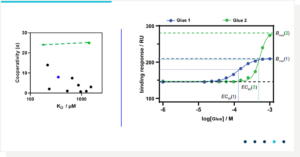
Figure 10 | Binary affinity and cooperativity represent distinct dimensions of molecular glue activity. The thermodynamic cycle illustrates the relationship between binary binding and ternary complex formation. The order of binding is not important; the cycle highlights that the energetic contribution of binary binding and the additional stabilization arising from cooperativity are distinct components of the overall interaction.
In practice, this approach reduces the complexity of the optimization problem. Rather than optimizing an overall glue response without knowing which underlying property is changing, we can deliberately optimize binary affinity while monitoring cooperativity or explore changes that increase cooperativity while maintaining sufficient binary binding. This provides clearer SAR and a more rational basis for prioritizing compounds during molecular glue optimization.
Lesson 10: Binary structures can guide molecular glue optimization
The difficulty of obtaining ternary structures can make structure-based optimization of molecular glues appear particularly challenging. In our experience, however, a ternary structure is not always required to improve the binary affinity of a molecular glue. When a binary protein-ligand structure can be obtained, it can provide a clear starting point for conventional structure-based drug design while cooperativity is monitored independently using biophysical measurements.
This is a direct consequence of treating binary affinity and cooperativity as separate optimization dimensions. Structural information from the binary complex can be used to identify opportunities to improve interactions with the protein, while measurements of the ternary system determine whether these modifications preserve the cooperative effect.
A previously published example from our work on 14-3-3 molecular glues illustrates this approach[30]. In this series, structural analysis identified an opportunity to introduce an additional hydrogen-bonding interaction with the protein. Replacing an ester with an amide increased binary affinity from approximately 300 µM to 10 µM, while cooperativity remained essentially unchanged (Figure 11).
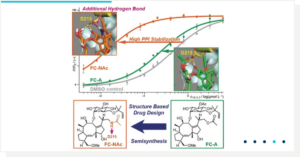
Figure 11 | Binary structure-guided optimization of molecular glue affinity. Replacement of an ester with an amide introduced an additional interaction with the protein and improved binary affinity from approximately 300 µM to 10 µM. Importantly, cooperativity was retained, demonstrating that binary affinity can be optimized independently while monitoring the cooperative component of the interaction.
This approach can substantially simplify the optimization problem. Rather than requiring a ternary structure to guide every chemical modification, binary structural information can be used to optimize one dimension of molecular glue activity, while biophysical measurements provide the feedback needed to ensure that cooperativity is maintained. Ternary structures remain highly valuable for understanding the molecular basis of cooperativity, but they do not necessarily need to be a prerequisite for productive optimization.
Conclusion
Discovery of molecular glues is frequently perceived as serendipitous, but we have seen that you drastically improve the odd using a systematic approach to the discovery and early optimization of cooperative small molecules.
A suitable protein-protein interaction provides an important foundation for successful glue discovery. When a measurable interaction can be established under the assay conditions, cooperative compounds are easier to identify. It’s worthwhile investing time in setting up the right conditions and finding the right protein constructs before screening. In screening we do prioritize cooperativity over affinity. Once the right conditions have been found, glues are actually way more abundant than expected.
Once cooperative hits are identified, measuring binary affinity and cooperativity separately provides a more informative basis for prioritization and optimization than overall “ternary activity” alone. It allows us to select or prioritize the most cooperative compounds. Rapid exploration of readily available analogues can then provide early evidence of coherent SAR-like behavior and determine chemotype tractability. Splitting cooperativity from binary affinity also enables improving binary affinity using structure-based approaches without necessarily requiring a ternary structure.
Together, these principles suggest that molecular glue discovery does not need to be approached as an entirely empirical process. The behavior of a ternary system remains complex, and successful discovery can never be guaranteed. However, careful selection and preparation of the protein pair, quantitative biophysical measurements and systematic hit validation can reduce uncertainty at each stage of the process and provide clearer decision points for progressing molecular glue programs.
The goal is therefore not simply to find compounds that bind two proteins, but to understand why they work, which properties make them effective, and how those properties can be optimized. This provides a more rational path from an initial cooperative fragment to a molecular glue that doesn’t depend solely on serendipity but is embedded in understanding cooperativity.
 Contact Our Molecular Glue Expert