Lessons Learned from Molecular Glue Discovery Campaigns (Part 2)
Discovery of molecular glues is frequently perceived as serendipitous. Drawing on 12 fragment-based molecular glue screening campaigns across diverse protein pairs, we highlight ten practical lessons that consistently influenced screening outcomes. In Part 1, we explored how intrinsic protein-protein affinity and thermodynamic modelling can help establish sensitive molecular glue screens. In Part 2, we turn to practical lessons from our screening campaigns, covering how to select suitable E3 ligases, identify cooperative hits, distinguish genuine glue activity from artefacts, and prioritize compounds for further optimization. Together, these lessons illustrate how thoughtful assay design and systematic follow-up can make molecular glue discovery more predictable and efficient.
Lesson 4: E3 ligase profiling helps identify suitable protein pairs
As we have seen in Part I, a measurable intrinsic affinity for protein-protein interaction is a good starting point for molecular glue discovery. The affinity between the proteins doesn’t need to be strong, but having a weak interaction makes gluing much more feasibility than having no affinity at all. It is therefore somethings worthwhile to profile several E3 ligases against a target before committing to a screening campaign[14]. Ideally, the E3 selection is based on prior knowledge [15] [16], for example known degradation from literature[17].
At ZoBio, we have several established E3 ligases available for this ligase profiling. We perform protein titrations to assess both the affinity of the interaction and the quality of the resulting SPR sensorgrams. Again, measurable interaction is useful, but clean, good quality sensor grams with limited nonspecific binding are equally important for establishing a robust screening assay.
Figure 5 illustrates E3-profiling for a target we recently tested against a panel of commonly used E3 ligases. The panel included VHL, CRBN and DCAF11. We also evaluated several constructs of the target. CRBN showed an interaction across all tested constructs, consistent with published literature showing CRBN based degradation of the target with a PROTAC. DCAF11 showed weaker, less promising interaction, while the other tested ligases did not show similarly compelling results. The interaction was particularly clean with CRBNmidi, an engineered CRBN construct for biophysics[18]. Moreover, competition with a known binder of the target protein knocked out the protein-protein interaction completely.
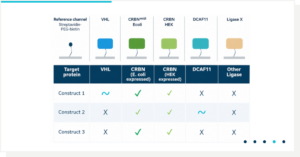
Figure 5 | E3 ligase profiling. Schematic representation of the SPR assay setup, comprising a reference channel and various E3 ligase surfaces: VHL, CRBNmidi, CRBN-FL, DCAF11 and another ligase. The table below summarizes the responses observed for three target protein constructs across the ligase panel. Checkmarks indicate binding responses, crosses indicate no detectable binding, and wavy symbols indicate an intermediate or ambiguous response, mostly non-specific. Titration towards CRBN resulted in the clean binding in line with previous knowledge.
The CRBNmidi interaction provided a suitable starting point for screening, requiring only minor optimization of the regeneration conditions. This example illustrates how E3-ligase profiling can combine prior biological knowledge with direct biophysical measurements to identify protein pairs that are both promising for molecular glue discovery and practical to screen.
Lesson 5: Molecular glues may be more common than expected
One of the more surprising observations from our screening campaigns is that cooperative binding is not exceptionally rare when a suitable protein-protein interaction is present. We have observed this even in screens that were originally designed to identify conventional inhibitors rather than molecular glues.
In these cases, compounds pop up as enhancers that could moreover also be confirmed subsequently as glue through concentration response titrations. Of course, in this context, these compounds don’t have the desired mechanism of action through the perspective of an inhibitor program, but their occurrence highlights that small molecules capable of inducing cooperativity are encountered relatively frequently.
Below in Figure 6 are the results for a molecular glue screen of the ZoBio Fragment library using an immobilized E3 ligase and a protein target in solution. The primary screen produced a substantial number of hits, alongside a smaller number of conventional inhibitors. Compounds were co-injected at 500 µM together with the target protein and the signal was normalized against the target protein only. Because the target protein has a relatively large molecular weight compared to the fragment; a small effect due to cooperativity has thus a large effect on the signal. Compounds that reached the threshold, were further inspected for a good quality sensor gram and marked as primary hit. Follow-up concentration-response measurements confirmed the activity of 41 of the selected 85 primary hits (see example on the right).
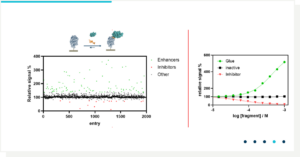
Figure 6 | SPR Fragment Glue screen. On the left: Molecule glue screen of the ZoBio fragment library using the SPR based molecular glue assay described above. Compounds are co-injected together with the target protein. Each dot represents a single compound. The signal is normalized against the target protein with DMSO. Responses below 100% represent fragments that compete with the host protein for binding to the immobilized peptide. Those above 0 indicate compounds that increase the protein-protein interaction and thus are likely glues. Compounds that pass the threshold are colored in green for enhancers or red for inhibitors are shown. These are further inspected. On the right: example of compounds concentrations response titrations of a confirmed glue, inactive and inhibitory fragment from the screen.
Interestingly, theses screens do not simply produce a small number of isolated “lucky” hits. Instead, multiple compounds showed characteristics consistent with cooperative activity, providing further evidence that, when the underlying protein-protein interaction and assay conditions are suitable, molecular glue activity may be a more accessible property to discover than is sometimes assumed.
Together, these observations have changed how we think about molecular glue screening. When the conditions are right, we are quite confident that a screen will produce hit. Protein interaction surfaces seem to be quite amenable for modulations by small molecules.
Lesson 6: Cooperativity matters more than affinity alone
Cooperativity is a key parameter guiding the early discovery and prioritization of molecular glues [19]. This cooperativity becomes apparent in concentration-response measurements, where compounds with similar or even weaker apparent affinity can produce substantially different levels of protein-protein stabilization.
We therefore quantify cooperativity using the α-factor as early as possible. In our campaigns, initial molecular glue hits typically have α-factors between 5 and 40, although values as high as 200 have been observed. The example below (Figure 7) illustrates how a compound with weaker binary affinity can nevertheless produce a stronger ternary response when its cooperativity is substantially higher. To visualize this well plot the hits in a cooperativity-affinity plot[20], ploting the intersic affinity of the fragment (KDII) versus the cooperataivity factor (α).
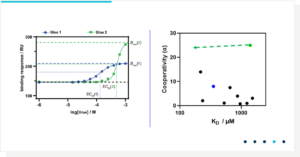
Figure 7 | Cooperativity can outweigh apparent affinity when prioritizing molecular glue hits. Concentration-response measurements for representative compounds illustrate how ternary response depends on both intrinsic affinity and cooperativity. The blue compound has a relatively stronger intrinsic affinity (KDbinary = 0.5 mM) but lower cooperativity (α = 5), whereas the green compound has weaker affinity (KDbinary = 2 mM) but substantially higher cooperativity (α = 20), resulting in a greater maximal response. An analogue further illustrates that affinity can be improved while retaining or increasing cooperativity (KDbinary = 0.8 mM, α = 41). These measurements support prioritizing highly cooperative compounds for subsequent analogue and structure-based optimization.
Hits that are highly cooperative compounds are particularly attractive starting points for further optimization. While affinity can be improved through traditional medical chemistry effort, designing in cooperativity is much more challenging. For this reason, we prioritize cooperativity over affinity during hit selection and then aim to improve the affinity through exporting nearby analogue followed by structure base design. We first rapidly assess approximately 10 carefully curated analogues from the ZoBio in-house collection that are readily available. This provides an early indication of whether the fragment hit represents a tractable chemotype and can reveal more potent analogues.
We then use structure-based drug design to improve affinity while retaining cooperativity. In our experience, improving affinity through conventional medicinal chemistry is generally easier than increasing cooperativity, making preservation of a high α-factor an important consideration during optimization. We visualize this relationship using a cooperativity-affinity plot (Figure 7, on the right), which helps guide the prioritization of compounds and chemotypes for further development.
Lesson 7: Compound-induced co-aggregation is not gluing
One of the major challenges in molecular glue discovery is distinguishing genuine cooperative binding from compound-induced protein aggregation[21]. Compounds that co-aggregate both proteins can superficially resemble ternary complex formation. However, these signals do not represent a productive ternary complex and therefore do not provide a useful starting point for molecular glue discovery.
Characteristic features can sometimes be observed in the SPR sensorgrams for the primary screen, providing an early indication that a strong response may not represent specific binding[22]. In the example below, a compound causes a large increase in signal, however the injected protein with compound doesn’t properly dissociate from the surface (Figure 8).
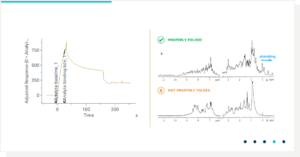
Figure 8 | Compound induced protein aggregation is a potential source of false positives. On the left, a SPR sensorgram from a compound flagged as suspicious (in brown). This compound induces stickiness of the protein in solution and retains on the SPR chip surface. DLS measurements on the right confirm that this compound induces protein aggregation and is thus not a real molecular glue.
We therefore do various orthogonal measurements as follow-up to identify and remove aggregation inducing compounds. Techniques such as DLS/DSF and NMR can provide complementary evidence for changes in protein or compound behavior and help distinguish genuine interactions from nonspecific effects (Figure 8). DLS shows possible formation of large species[23], while H-NMR can check for proper folding of the protein[24]. These techniques can weed out ill-behaved hits, to ensure the right mode of glue action.
Together, these lessons show how careful selection of protein pairs, thoughtful assay design and systematic follow-up can improve the chances of identifying genuine molecular glue hits. In Part 3, we will explore how to validate promising chemotypes, distinguish binary affinity from cooperativity and use structural information and early analogue exploration to guide molecular glue optimization.
 Contact Our Molecular Glue Expert