Lessons Learned from Molecular Glue Discovery Campaigns (Part 1)
Practical insights from 12 fragment-based molecular glue screens
Discovery of molecular glues is frequently perceived as serendipitous. Drawing on 12 fragment-based molecular glue screening campaigns across diverse protein pairs, we discuss nine practical lessons that consistently influenced screening outcomes. These include the role of intrinsic PPI affinity, cooperativity, quantitative characterization, hit triage and assay design. While molecular glue discovery remains challenging, several principles can help to improve the probability of discovering cooperative compounds.
Introduction
Molecular glues have emerged as an attractive approach for modulating proteins through inducing or stabilizing protein-protein interactions (PPIs) [1]. Rather than binding to a conventional active site or functional pocket, molecular glues create or stabilize protein-protein interactions, opening opportunities for targets and mechanisms that may be difficult to address with conventional small molecules. The field has gained considerable momentum in recent years, driven by the success of approved molecular glue drugs such as lenalidomide[2], pomalidomide and daraxonrasib[3], as well as a growing pipeline of next-generation molecular glues advancing through clinical development.
Despite growing interest in molecular glues, the discovery of new molecular glues remains challenging and is often perceived as highly serendipitous. While new approaches are emerging to optimize and repurpose existing molecular glue chemotypes, the de novo discovery of cooperative small molecules remains a significant challenge.
A fundamental challenge lies in the complex thermodynamic behavior of ternary systems. Molecular glue hits must satisfy two requirements: sufficient affinity for one or more components of the system and the ability to induce ternary complex formation through cooperativity. This “double filter” creates a high barrier for conventional screening approaches. On the other hand, literature shows that molecular glues don’t have to be complex molecules; many glues have surprisingly simple structures (Figure 1). Lenalidomide and auxin[4] are examples for very small, almost fragment like, molecular glues. This raises the question: How do we find molecular glues? How can cooperative compounds be distinguished from conventional binders or assay artefacts? And how can screening Conditions be optimized to maximize the likelihood of detecting cooperative interactions?
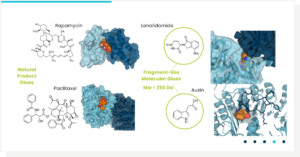
Figure 1 | Overview of well-known molecular glues. Molecular glues don’t need to be complex natural products. This is highlighted by fragment-sized glues such as lenalidomide and auxin that are both below 250 Da. pdb: 1FAP [5], 1JFF[6], 5FQD[7], 2P1Q [4]
At ZoBio, we have approached these challenges through a fragment-based molecular glue discovery workflow built around biophysical characterization and a thermodynamic framework [8], [9]. While molecular glue discovery is often portrayed as highly empirical, in our experience several recurring factors consistently influence the probability of success. Intrinsic protein-protein affinity, cooperativity, and assay design repeatedly emerge as important determinants of whether productive molecular glue chemotypes can be identified and characterized. These principles allow us to make more informed decisions when designing screening systems and to distinguish the different contributions to molecular glue activity during hit characterization and optimization.
To date, we have performed 12 molecular glue screening campaigns across different protein pairs using a fragment library of approximately 1,700 compounds. These campaigns have provided an opportunity to test and refine our approach across a range of protein-protein interactions. Some observations confirmed aspects that were already built into our screening philosophy, while others challenged our assumptions and led us to refine how we design, execute and interpret molecular glue screens.
In this article, we highlight some lessons that we believe are particularly relevant to the practical discovery and early characterization of molecular glues. Together, these lessons support a systematic approach to molecular glue discovery in which the probability of success can be influenced at each stage, from selecting and establishing suitable protein-protein interactions through identifying and prioritizing cooperative hits, rapidly validating chemotypes, and guiding their subsequent optimization. Our approach is centered around biophysical techniques, many of the principles discussed here extend beyond SPR and NMR and are relevant to molecular glue discovery more broadly. We hope these lessons contribute to make the discovery of new molecular glues more systematic rather than dependent on serendipity.
Lesson 1: Protein recruitment amplifies detection
In order to generate as much sensitivity as possible to find new molecular glues, we heavily rely on biophysical methods such as SPR. In SPR, the signal is proportional to the mass that is recruited to the surface of the sensor chip[10]. In our assay format, one protein is immobilized on the sensor surface, and the second protein is co-injected with the fragment. Though fragments are relatively small, the compound does not need to generate the majority of the response itself. When a fragment stabilizes the interaction between the two proteins, it recruits the second protein to the sensor surface, the resulting response reflects the mass of the recruited protein rather than the fragment alone. A fragment of a few hundred daltons can therefore produce a substantial signal by recruiting a protein that is tens of kilodaltons in size.
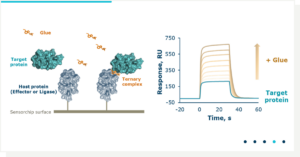
Figure 2 | Surface Plasmon Resonance assay for detecting Molecular Glues.
A) Schematic presentation of an SPR assay setup where the binding between the target protein and host protein is monitored in the presence or absence of molecular glue. Fragments are protein are co-injected together.
B) SPR signal from the binding of the injected protein (blue) to the surface is greatly enhanced in the presence of glue, leading to a large increase in signal facilitated by the high molecular weights of proteins relative to fragments.
This creates an important advantage for fragment-based molecular glue screening. Rather than relying on the relatively small signal generated by fragment binding alone, int the assay the molecular glue effect results into recruitment of a much larger protein, providing a sensitive readout for cooperative binders [11].
Lesson 2: Measurable native or intrinsic protein-protein interactions greatly increase the likelihood of finding molecular glues
Molecular glues enhance the affinity between two proteins by stabilizing their interaction through cooperativity. Lesser known is that this cooperativity works both ways [8]: the glue strengthens the protein-protein interaction, but the interacting proteins also enhance the apparent affinity of the glue (Figure 3) [9]. Therefore, it is significantly easier to discover molecular glues for protein pairs that already exhibit a least weak but measurable binding. In our experience, even interactions with affinities around 1 mM can provide a suitable starting point for glue discovery.
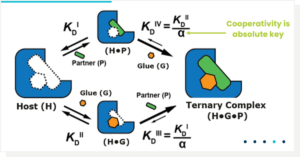
Figure 3 | Thermodynamic cooperativity model demonstrating cooperativity goes two ways. Two proteins, a host (H) and a parter (P) bind each other with an affinity KDI. If the molecular glue is already prebound, this affinity is enhanced (in the case of positive cooperativity) to KDIII. Likewise, the molecular glue (G) that binds the host protein with a KDII and is enhanced with the same cooperativity factor (α) in the partner is prebound.
Remarkably, every protein pair for which we could establish a measurable intrinsic interaction yielded cooperative hits during screening. Two campaigns in which no measurable intrinsic interaction could be established produced binary binders, but no cooperative hits through dose response.
This does not mean that there is a universal affinity threshold for molecular glue discovery. Rather, what matters is the relationship between the intrinsic affinity of the protein pair and the protein concentrations that can practically be used in the assay. Protein concentration is inherently limited by factors such as protein availability, stability and assay performance such as stickiness and reference binding. Consequently, sufficiently strong intrinsic affinity to populate the interacting state under suitable assay conditions becomes an important practical consideration.
During assay development, we devote therefore significant effort to selecting suitable immobilization strategies, evaluating alternative protein constructs and optimizing assay conditions before initiating a screening campaign. Even modest improvements in the measurable protein-protein interaction can meaningfully increase the fraction of the interacting state under the assay conditions and thus the sensitivity of the screen.
Lesson 3: Thermodynamic models provide a framework for designing and interpreting glue screens
Molecular glue screening is fundamentally governed by equilibrium thermodynamics. The concentrations, affinities and cooperativity of all components determine whether ternary complexes can form and be detected[12]. In principle, the highest assay sensitivity is often achieved when the protein-complex is approximately 50% pre-formed, typically with protein concentrations are close to the KD of the interaction. In practice, however, this is often not feasible, and trade-offs need to be made. Thermodynamic modeling provides a quick way to integrate all relevant parameters and predict how changes in assay conditions are expected to affect the formation of the ternary complex and what trade-offs to make.
We use this framework during assay development, combining the measured protein-protein affinity with fragment affinities measured in previous campaigns and realistic ranges of affinity and cooperativity [9], [13]. This allows us to estimate the expected assay response and identify conditions that are likely to provide a useful screening window and identify the limitations of the screen prior to embark on an extensive assay optimization.
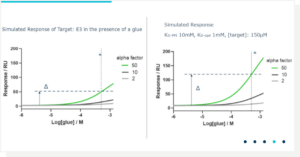
Figure 4 | Example of simulated assay response for a glue system with an intrinsic protein-protein affinity of 10 mM. On the left the response is plotted for when there is 50 µM protein in solution. In this case only very cooperative compounds can be detected reliable. On the right the same simulation is done with 150 µM protein in solution. In this scenario, the response is much higher.
Through modeling, a scenario with a 10 mM protein-protein affinity, increasing the protein concentration from 50 to 150 µM can substantially change the expected response to a cooperative compound, at the cost of higher protein consumption. This illustrates why protein concentration and intrinsic affinity need to be considered together when designing a molecular glue screen.
Thermodynamic modeling allows assay development to guide with quantitative predictions, accelerating to identify conditions that are most likely produce cooperative hits.