SPR services that deliver reliable binding data
While SPR experiments are easy to perform, designing assays that yield reliable data is challenging, particularly for complex biological systems where standard methods are insufficient.
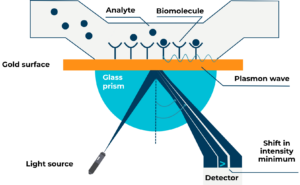
Why SPR experiments often fail to deliver useful insight
Surface Plasmon Resonance is a powerful technique, but its success depends on proper assay setup. Proteins often lose activity during immobilization or behave differently once attached to the sensor surface, leading to signals that are difficult to interpret or do not represent true biological interactions.
Since immobilization is also a core requirement in ZoBio’s proprietary TINS technology, extensive expertise has been developed in preserving protein functionality and validating biological activity under assay conditions.
Even when binding is observed, distinguishing true interactions from artifacts can be difficult. This uncertainty affects affinity, kinetics, and ultimately the decision to pursue a compound or interaction.
What ZoBio’s SPR services can enable in your project
The goal of SPR is to generate reliable, interpretable data that supports decision making throughout discovery, not just to measure binding.
Our SPR assays can be designed to:
- confirm protein function and biological relevance
- validate tool compounds and early hits
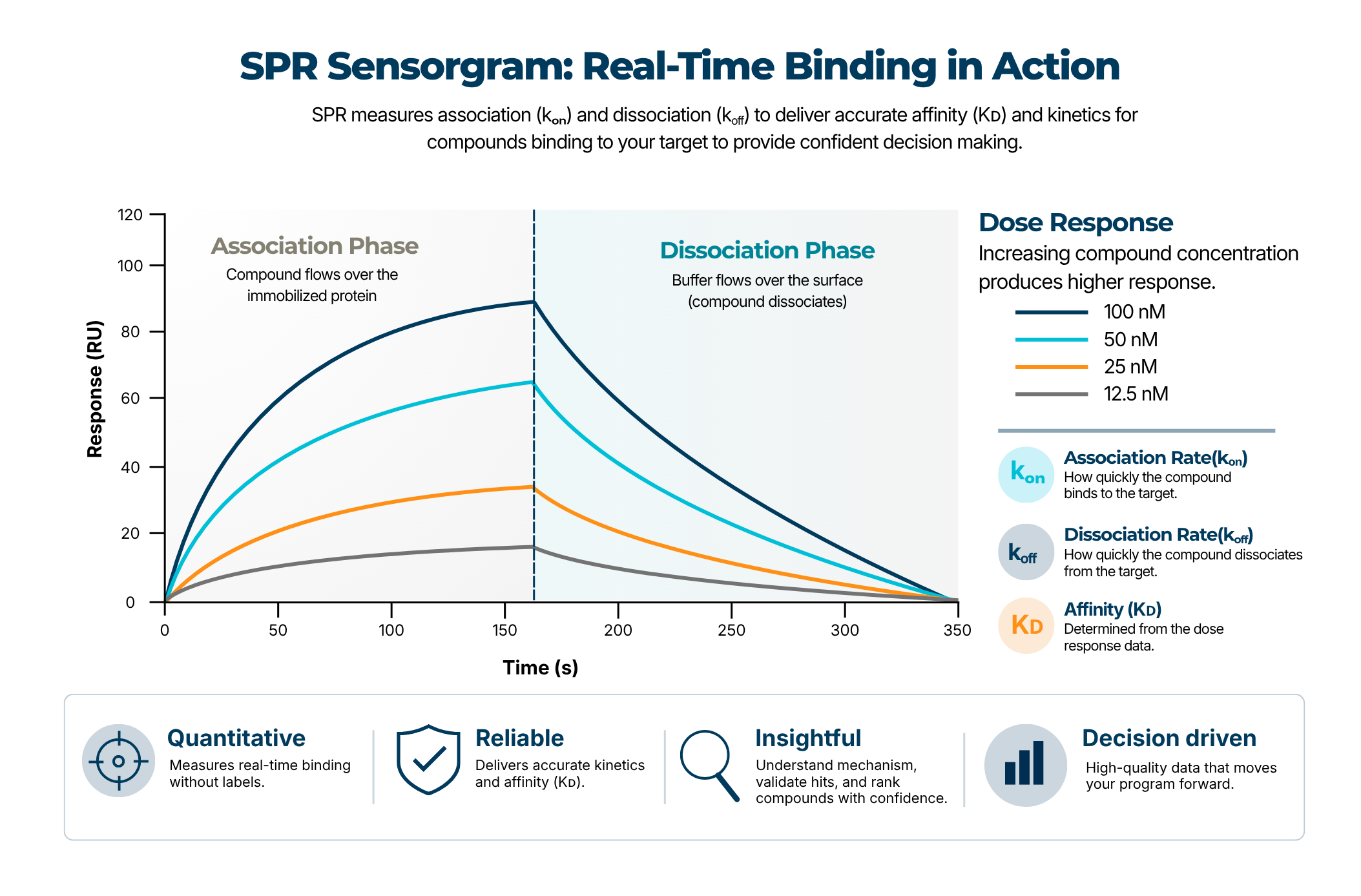
- characterize binding affinity (KD) and kinetics (kon/koff)
- support progression from hit identification to lead optimization
SPR measures interactions in real time, offering detailed insight into binding behavior from weak fragments to high-affinity compounds. This enables early identification of meaningful differences and supports prioritization based on affinity and kinetics.
Experience with challenging assay systems
Establishing a functional SPR assay is often the main challenge, especially for today’s more challenging targets such as Molecular Glues. ZoBio has over 20 years of experience in SPR experiment design, specializing in protein immobilization and assay optimization. This expertise covers cases where proteins lose activity during immobilization or standard formats fail to yield interpretable data.
This experience enables the development of assays for challenging systems that deliver meaningful and actionable results.
How our SPR assays are developed and applied
SPR experiments do not follow a fixed protocol. Each assay is tailored to the target and specific biological question. The process begins with protein preparation and immobilization, ensuring the target remains functional on the sensor surface. Maintaining biological activity is critical for assay quality. The assay is then configured to measure the interaction of interest, which may include:
- direct binding assays
- competition or blocking formats
- protein-protein interaction disruption assays
- stabilization assays for molecular glue discovery
Once established, the assay can be used throughout the project, from early validation to late-stage characterization.
Where ZoBio’s SPR service adds value across drug discovery
SPR is a flexible technique that supports multiple phases of a project:
Quantitative binding assays
SPR confirms protein function and characterizes biomolecular interactions such as protein–protein, protein–ligand, and protein–nucleic acid binding.
Fragment screening & hit identification
SPR enables rapid fragment library screening with minimal protein material and can be adjusted to identify specific binding modes, including allosteric interactions and protein–protein interaction inhibitors.
Hit validation & hit-to-lead
Hits from fragment, DEL, covalent, or external sources can be validated and characterized. Analogue libraries help confirm hits and support structural studies.
Late-stage development
SPR measures binding kinetics and residence time, providing insights for PK/PD optimization and dosing strategies.
What sets ZoBio's SPR approach apart
Many SPR services focus solely on running assays. The key difference is whether the assay is effective and the data can be interpreted with confidence.
ZoBio combines:
- deep expertise in protein immobilization
- flexible assay design tailored to the target
- experience across multiple screening modalities
- continuous interpretation and adaptation during the project
Instead of using a standard workflow, each assay is developed to address a specific biological question.
From binding data to actionable insight
SPR data is most valuable when it guides decision-making. By integrating assay design, real-time measurement, and interpretation, SPR can move a project from uncertainty to clarity. Whether confirming a target, validating hits, or prioritizing lead series, the goal is to generate data that directly supports the next step.
How can we help your drug discovery work to achieve real solutions?
 Location
ZoBio BV
J.H. Oortweg 19
2333 CH Leiden
The Netherlands
 Phone number
+31-71-2040580