Fragment screening services built around what your target actually needs
Fragment screening services are valuable only when they enable clear decisions. The main challenge is not data generation, but ensuring results are reliable enough to determine whether to advance or halt a program.
If the assay does not perform as expected, even well-run screens may yield data that appears convincing but fails validation, leaving no solid foundation for the next steps.
Why fragment screening often fails before it becomes useful
Fragment screening is well established, but the challenge is making it effective for a specific target. Often, proteins cannot be produced in a functional form or lose activity during immobilization (required for some of the most important screening assay formats). Assays may generate signals but lack the specificity to distinguish true binders from artifacts. This leads to data that appears promising but does not support clear decisions.
At this stage, you must either stop early or proceed with compounds that may not validate, both of which cause delays and add unnecessary risk.
How our fragment screening services enable informed decisions
Our goal is to deliver confirmed hits with a defined mode of action and clear next steps, not just generate hits.
ZoBio designs fragment screens tailored to the target and biological question. Assays are developed to detect relevant interactions and differentiate them from non-specific, interfering and other artifactual interactions. The process yields a validated, prioritized hit list, supported by affinity data and expert interpretation, enabling teams to distinguish meaningful interactions from noise and make informed decisions.
In practice, the outcome is clarity on which compounds are relevant and the appropriate next steps, not just data.
We are used to working on challenging targets, especially those where previous efforts have not yielded usable data.
ZoBio has over 20 years of experience establishing functional assay systems for fragment screening, with more than 100 successful cases. This includes projects where others tried to immobilize proteins without loss of activity but failed or where initial assay formats failed to yield interpretable data.
“We didn’t just receive data. We understood which compounds were relevant and how to move forward, which directly influenced our decisions.”
For a practical example, see our YTHDF2 case study, where fragment hits advanced to validated starting points. We focus on reaching a clear go or no-go decision early, ensuring resources are directed toward promising approaches.
How we structure fragment screening campaigns
Committing to a full screen without proven feasibility introduces unnecessary risk; our campaigns follow a staged approach. This approach confirms the system is effective before scaling up.
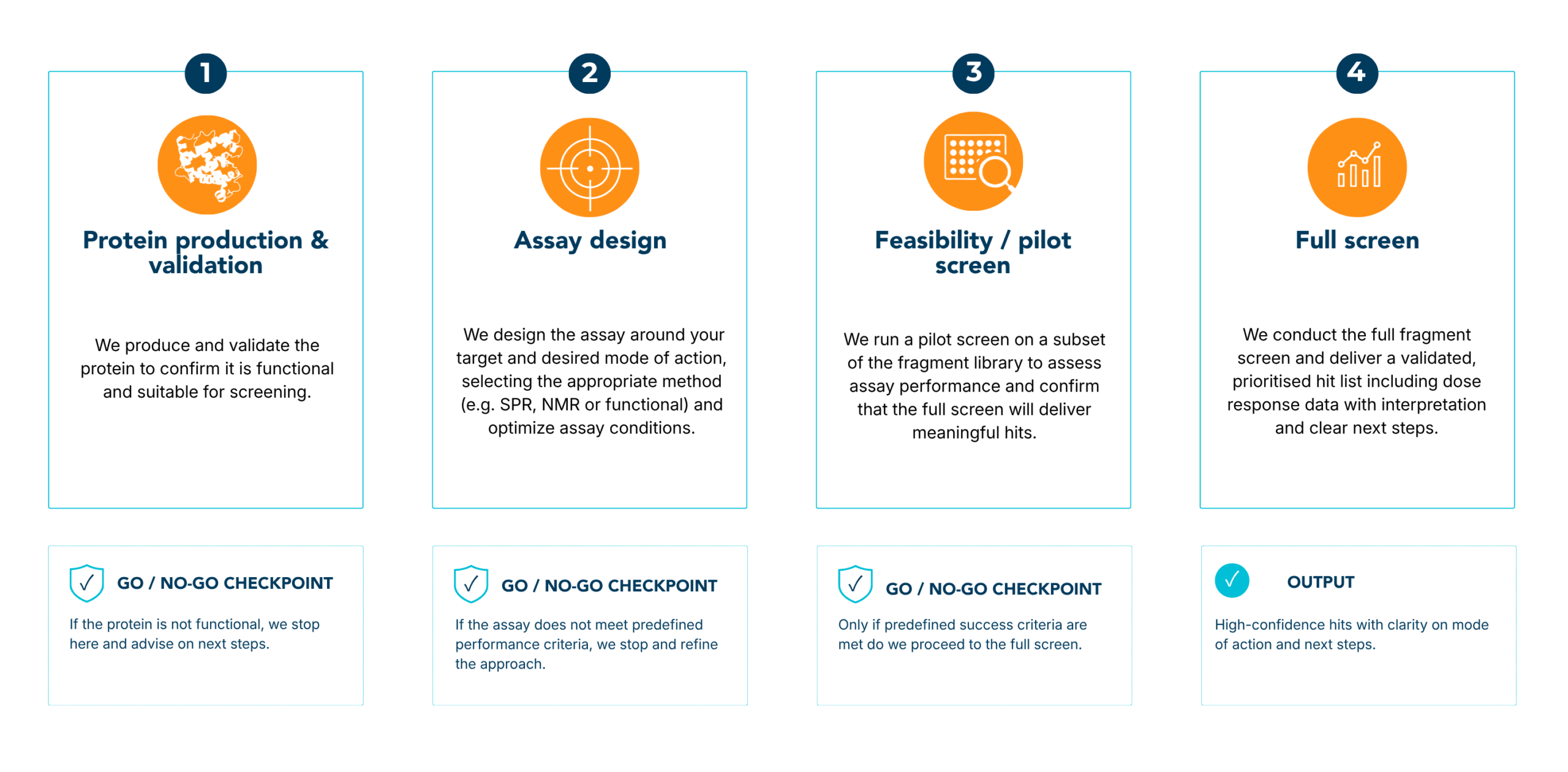
Why our clients choose ZoBio over standard CRO workflows
Many providers offer fragment screening, but the key difference is whether the system works for your specific target and supports your decision making.
ZoBio leverages expertise in protein engineering and immobilization to establish functional assay setups, even for targets that have proven difficult or failed elsewhere. Instead of using a generic workflow, our team designs each screen around the desired mode of action and your goals and limitations. This enables the identification of compounds with specific biological mechanisms rather than non-specific binding.
We don’t deliver raw datasets in isolation but interpret results in context and adjust the approach as new insights emerge during the project.
Coming soon:
From fragment hits to validated starting points without delay
Identifying hits is only the first step; the ability to act on them determines the overall value of your campaign.
To support this, ZoBio is building an in-house analog library that enables immediate follow-up of identified hits. Instead of waiting 6-8 weeks for purchase or external synthesis, validation can begin as soon as results are discussed. In practice, this can remove 5 or more weeks from early-stage timelines and help you maintain momentum in drug discovery programs.
How can we help your drug discovery work to achieve real solutions?
 Location
ZoBio BV
J.H. Oortweg 19
2333 CH Leiden
The Netherlands
 Phone number
+31-71-2040580