NMR services that provide binding insight that guides
NMR experiments yield detailed data, but their value relies on effective design and interpretation. The key challenge is understanding the significance of detected interactions for your target and determining appropriate next steps.
Why NMR experiments often fail to translate into decisions
NMR remains a bit of a niche in small molecule drug discovery since its effective application requires deep expertise. Careful control of sample composition, protein quality, and experimental conditions is essential, but it’s only the starting point. In order to design, correctly implement and interpret an NMR experiment, it’s critical to understand the underlying physical chemistry. Without this, spectra can be difficult to interpret or may not reflect biologically relevant interactions.
Different NMR approaches yield distinct information. Choosing the wrong method can result in incomplete or misleading conclusions about binding, affinity, or binding site location.
As a result, projects may produce extensive data without achieving the clarity needed to advance.
What NMR should enable in your project
The goal of NMR is to deliver direct insight into molecular interactions and their biological relevance, not simply to generate spectra.
NMR experiments can:
- detect binding in solution without labelling artifacts
- confirm and characterize compound interactions with your target
- determine binding affinity where applicable
- map interaction sites at residue level
- support structure-informed design decisions
Since measurements occur in solution, NMR can detect interactions that are challenging for other techniques, such as weak binders and dynamic systems.
The outcome is a clear understanding of how a compound interacts with the target and whether it merits further pursuit, not just detection of binding.
Experience with complex targets and NMR systems
Effective use of NMR in drug discovery requires both technical expertise and sound experimental judgment. ZoBio scientists have more than 4 decades of combined experience in NMR-based drug discovery with deep understanding of the underlying science. Our team has demonstrated expertise in the development of NMR methods and their successful implementation in a commercial drug discovery setting as evidenced through peer reviewed publications. We routinely use NMR for fragment screening, orthogonal confirmation of compound binding, and structural biology.
Our expertise covers proteins, RNA targets, and systems where other techniques offer limited insight. This experience enables us to design experiments for complex systems that yield interpretable and actionable results.
How NMR experiments are selected and applied
NMR comprises a set of complementary approaches, and selecting the appropriate method is critical.
Two main strategies are used:
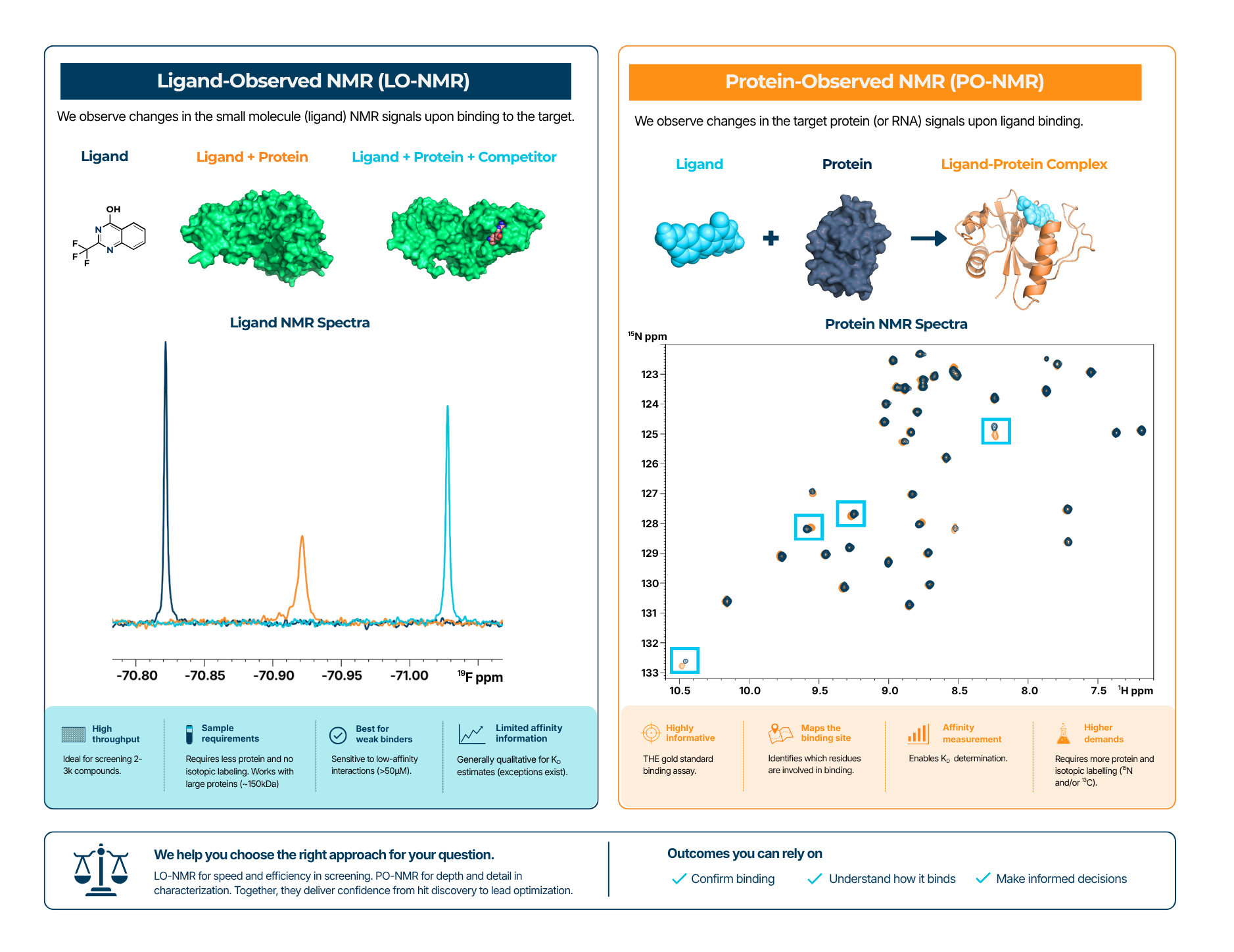
Where NMR adds value across drug discovery
NMR supports multiple stages of your project:
Fragment screening & hit discovery
Ligand- and protein-observed methods identify initial binding events and provide starting points for drug discovery.
Hit validation & characterization
NMR confirms binding, distinguishes specific from non-specific interactions, and maps interaction sites to guide medicinal chemistry.
Structure-informed drug design
NMR provides structural information in solution, including binding poses, especially when crystallography is not feasible.
Challenging systems
NMR enables analysis of systems like intrinsically disordered proteins, where other structural techniques are less effective.
What sets ZoBio’s approach apart
Other NMR services focus solely on running experiments. The key difference is selecting the right approach and interpreting data within the project context.
ZoBio combines:
- deep expertise in both ligand- and protein-observed NMR
- experience with complex targets and difficult systems
- integration with orthogonal techniques when needed
- continuous interpretation and adjustment during the project
Instead of following a fixed workflow, we design experiments to address specific biological questions.
Get started
From interaction data to actionable insight
NMR offers some of the most detailed insights into molecular interactions in drug discovery. However, its value depends on effective use of this information. Combining experimental design with interpretation, NMR can move a project from uncertainty to a clear understanding of binding mechanisms and next steps.
How can we help your drug discovery work to achieve real solutions?
 Location
ZoBio BV
J.H. Oortweg 19
2333 CH Leiden
The Netherlands
 Phone number
+31-71-2040580