X-ray crystallography services that transform structural data into informed decisions
X-ray crystallography is essential for determining protein–ligand structures. The primary challenge is generating sufficient quality structures quickly enough to support timely decisions in drug discovery.
Why crystallography can slow down drug discovery
Structural data is valuable, but crystallization is inherently challenging and often creates bottlenecks. Proteins may not crystallize, crystals may not tolerate ligand soaking, or data quality may be insufficient for clear interpretation. Even when structures are obtained, turnaround times may not align with medicinal chemistry cycles.
As a result, structural insights may arrive too late to inform decisions, reducing their impact on compound design and development.
What crystallography enables in your project
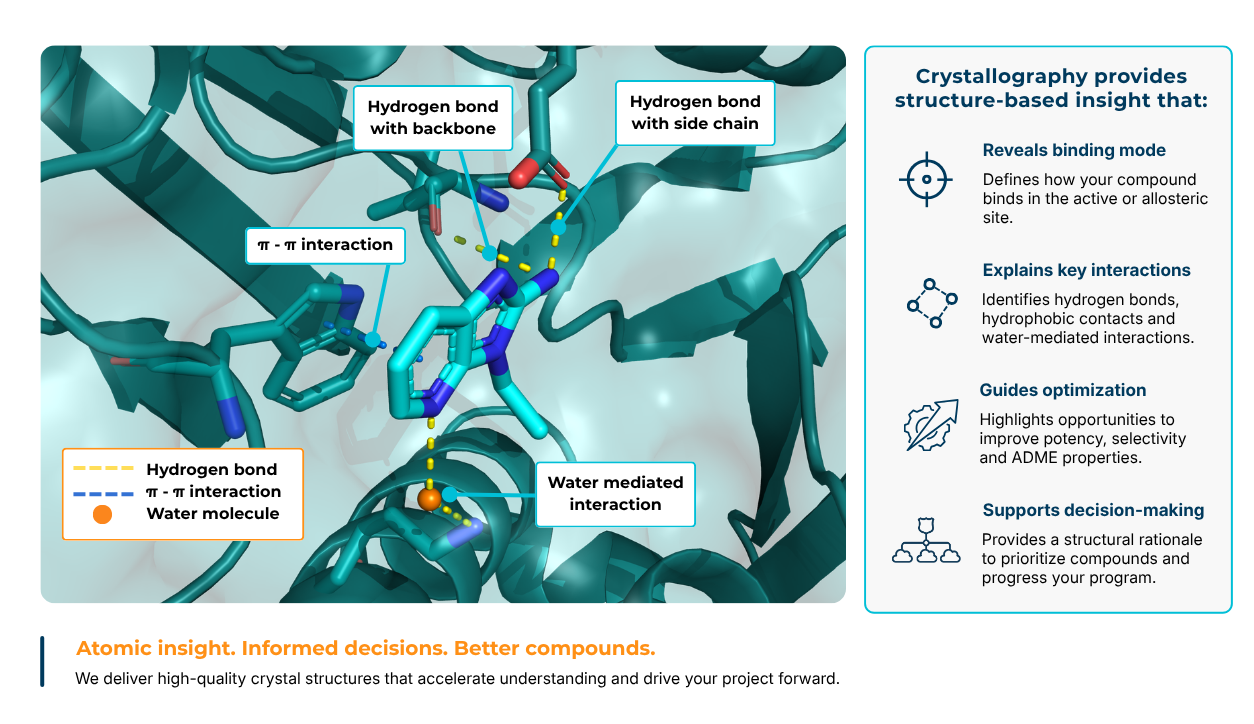
X-ray crystallography delivers atomic level insights into how compounds interact with your target, guiding your drug design strategy. Crystallography of protein-ligand structures provides structure-based insights that:
- reveal binding modes (characterize the binding of your compound to an active or allosteric site).
- explain key interactions – identifies interaction networks and maps any structural changes
- may identify previously unknown pockets or binding sites
- guides optimization – highlights opportunities to improve potency, selectivity and ADME properties
- supports decision-making – provides a rationale to prioritize compounds and progress your program
This information directly supports structure-based drug design, enabling rational optimization of compounds from fragment, DEL, covalent or other sources of hit matter. When applied effectively, crystallography allows teams to replace assumptions with structural evidence.
Experience with challenging crystallography systems
Successful crystallography requires more than equipment. It also demands expertise in protein preparation, crystallization strategies, and data interpretation. ZoBio offers over 20 years of experience in designing crystallography campaigns and solving complex protein–ligand structures. This includes projects where:
- no prior structural information is available
- existing crystal systems are not suitable for ligand studies
- protein engineering is required to enable crystallization
This expertise allows challenging targets to be converted into workable crystallography systems.
How crystallography campaigns are structured
Crystallography campaigns are designed to provide structural insights as early and efficiently as possible.
The process typically includes:
- careful study of the literature and available (predicted) structures
- protein engineering if required and establishing protein expression (bacterial or human systems) and crystallization conditions
- optimizing crystal systems for ligand binding
- applying soaking and/or co-crystallization strategies
- solving and analyzing protein–ligand structures
When feasible, soaking and co-crystallization workflows are conducted in parallel to maximize success rates. For fragment-based or focused library screening, compound sets are introduced into crystals using proprietary automated routines and systematically analyzed to identify bound ligands and new binding sites.
Where this approach differs from standard crystallography services
Many crystallography services focus solely on individual structure determination. The key distinction is whether the workflow supports active drug discovery. ZoBio operates an automated, customized crystallography platform designed for rapid, high-throughput structure generation. This enables:
- screening of libraries up to 500 compounds
- fast turnaround of structural data
- integration into iterative design cycles
Custom infrastructure with controlled temperature and humidity ensures crystal stability during handling. Frequent access to synchrotron facilities reduces waiting times and supports continuous workflows. Automated data pipelines allow rapid identification of bound ligands, often within 24 hours of data collection. We also offer exclusivity on your target as an extra layer of protection against your competitors.
From structural data to actionable insight
Structural information is most valuable when it directly informs compound design. Combining high-throughput crystallography with rapid data analysis provides structural insights on a timeline that supports medicinal chemistry cycles. This approach enables continuous refinement of compounds based on observed binding modes. For isolated structures, the result is a growing body of structural evidence that guides decision-making throughout the project.
How can we help your drug discovery work to achieve real solutions?
 Location
ZoBio BV
J.H. Oortweg 19
2333 CH Leiden
The Netherlands
 Phone number
+31-71-2040580