Chemically Diverse CRBN Starting Points for Molecular Glue Discovery
Cereblon (CRBN) is a clinically validated E3 ligase and the target of several approved molecular glue degraders. However, current CRBN glue discovery is largely built around glutarimide-containing ligands and their subsequent decoration, resulting in a relatively narrow chemical and vector space and crowded IP around established chemotypes. Moreover, not all molecular glue targets have a suitable ligand that can be readily adapted in this way.
To expand the available chemical starting points, ZoBio established a CRBNmidi-based ligand screening workflow and screened approximately 1,700 fragments. The campaign yielded 34 confirmed non-glutarimide CRBN binders, with affinities ranging from ~100 μM to 500 μM. 21 binders were thalidomide-competitive, while 13 showed no significant competition, revealing distinct binding profiles within the newly identified chemical matter. To further evaluate the identified chemotypes, a rapid analogue exploration campaign was performed using ZoBio's in-house compound collection, providing an initial assessment of structure–activity relationships and expansion potential.
Initial crystallography studies validated binding of selected fragments and revealed distinct binding modes with multiple exit vectors from the CRBN surface, opening new opportunities for molecular glue design.
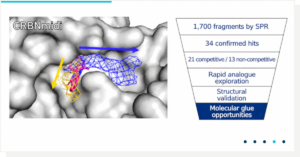
Figure 1. Overlay of non-glutarimide fragment hits bound to CRBNmidi validated via soaking (displayed as a density map, yellow and blue) and pomalidomide (shown as pink sticks for reference). The fragments feature different exit-vectors from the established imid-series.
Want to Explore New CRBN Starting Points? Talk to us about the CRBN fragment-derived chemical matter, hit expansion and opportunities for molecular glue discovery.
 Contact Our Molecular Glue Expert